
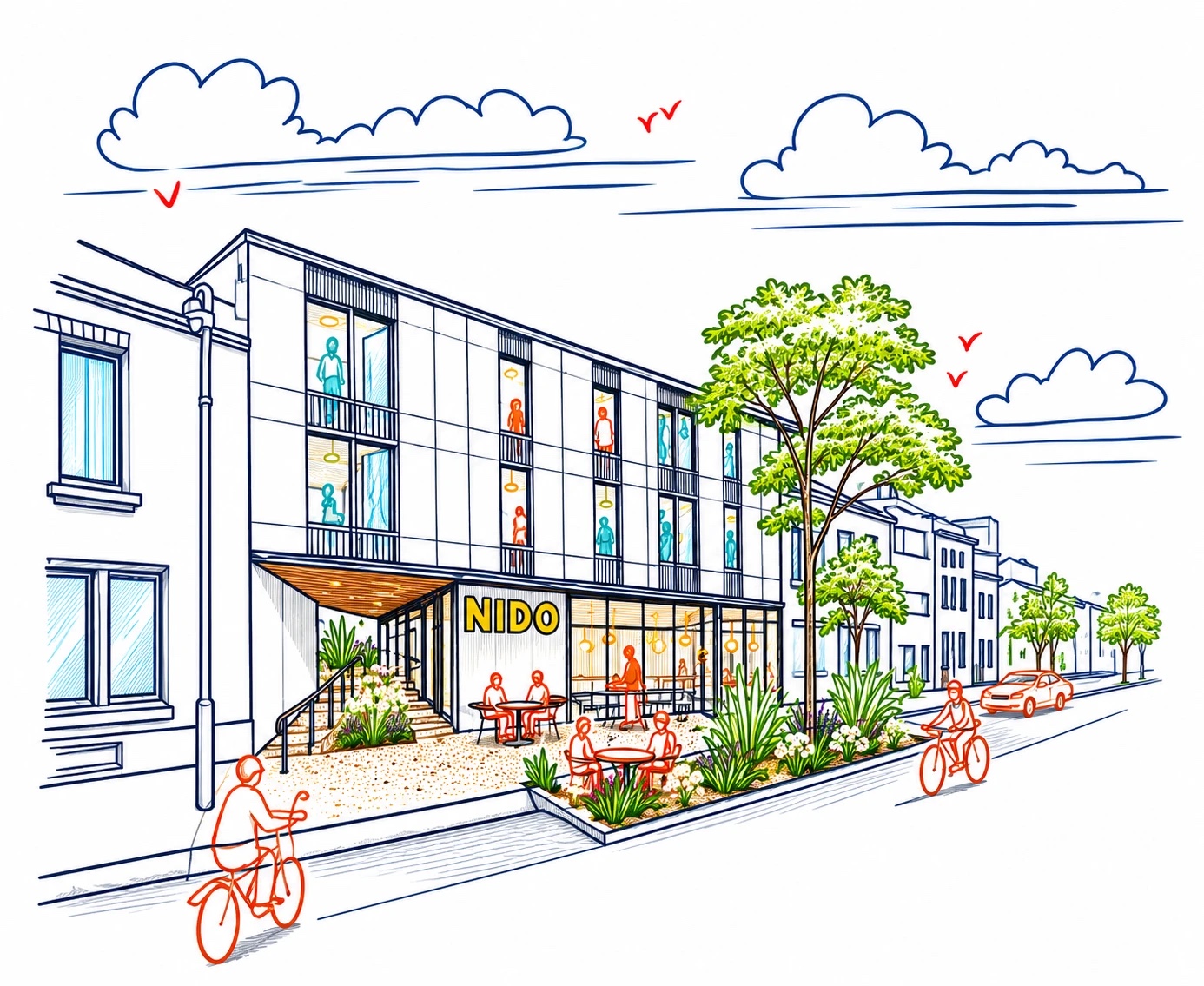
Thirty people with intellectual disabilities, autism spectrum disorder (ASD), or dual diagnoses will be housed in Haren (Brussels City), thanks to the construction of a new building and the renovation of the Nido asbl residential center. With a total budget of €3,000,000, the project is in the design phase: the application for a building permit is scheduled for spring 2027. The facility is scheduled to open in 2031.
What It Is
Founded in 1986 under the name “De Ark te Laken” to address the lack of residential facilities for children in special education, Nido vzw is a Dutch-speaking association based in Brussels. Today, it provides support in residential centers and day centers tailored to the specific needs of children and adults with intellectual disabilities or autism spectrum disorder (ASD).
Renamed Nido in 2025, the nonprofit organization symbolizes a warm, safe, and inclusive living environment where everyone can thrive and participate fully in society. The organization continues to expand to support every stage of life for people with intellectual disabilities, notably with the opening of a Dutch-speaking day center in Brussels—the first of its kind—designed for children up to age 8 with severe multiple disabilities.
Why This Construction Project Is Necessary
Families in Brussels—whether Dutch-speaking or French-speaking—continue to face a severe shortage of housing and care options for their loved ones with intellectual disabilities.
Located in the heart of Haren (Brussels City), the Nido residential center currently houses 10 people. This is insufficient to meet even the needs of the residents currently receiving care at the day center. Furthermore, the current infrastructure requires extensive renovation: it is no longer suited to the needs of its residents, and it also offers significant potential for expansion.
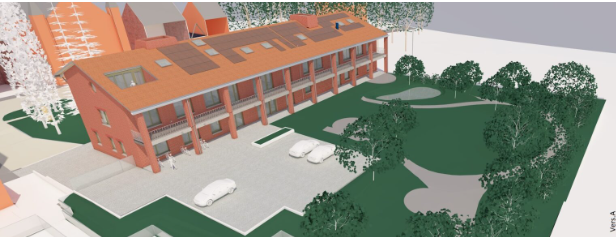
The acquisition of the lot adjacent to its current residential center allows Nido to achieve a twofold goal: to significantly increase housing capacity for people requiring 24-hour care, while modernizing the existing facility.
The two construction projects will proceed one after the other to ensure that current residents are temporarily relocated to the new facility while the old residence is being renovated. In total, between the new construction and the renovation of the existing building, Nido will create 30 residential spaces for adults with an intellectual disability and autism, most of whom also face psychiatric issues or behavioral disorders.
What Will Be Done
The project will be carried out in two phases:
- Phase 1: Construction of a new home for fourteen people with intellectual disabilities and/or ASD who require a high level of care. The building will be designed to address the sensory challenges associated with autism, while also taking into account an aging population and people with multiple disabilities.
- Phase 2: Renovation of the existing building, which will continue to serve individuals with similar needs (intellectual disabilities and/or autism), while creating 6 new residential spaces and ensuring full compliance with standards (compliant elevator for people with disabilities, insulation, safety), for a total of 16 residential spaces.
What is the status of the project?
The project to build and renovate the Nido homes in Haren represents a total investment of approximately €3,000,000. The initiative is still in its very early stages: initial preparatory meetings are scheduled for the coming weeks with the City of Brussels and with VIPA, the Flemish subsidy mechanism for healthcare infrastructure, which is affiliated with VAPH.
The planning permit application is scheduled to be submitted in the spring of 2027. Funding relies on the involvement of several public and private partners. Nido is counting on support from the VIPA and the Vlaamse Gemeenschapscommissie (VGC), and also hopes for assistance from the City of Brussels.
Constellations is assisting the association in securing the additional funding needed to bring the project to fruition. A substantial loan is planned to pre-finance the construction project: public subsidies from VIPA are spread out over the building’s lifespan and disbursed once it is occupied.
This project will modernize the existing infrastructure and bring it up to code, sustainably improve residents’ quality of life, and create a total of 30 residential care beds. Fourteen of these will serve a dual purpose as both a residential center and a specialized day center for adults with high levels of dependency.
The new facilities are scheduled to open in 2031.
 A question about Constellations?